Anxious at 2 a.m.? What helps right now


Anxiety is a feeling. It's your body's alarm going off with no fire in sight: a racing heart, a tight chest, the same what-if on repeat. At 2 a.m. it gets louder, because nothing else is competing for your attention. Two things help, in this order. First, slow your breathing for about a minute so your body turns the alarm down. Then talk the worry through until it shrinks back to its real size. You can do both in the next ten minutes without waking anyone up.
Name it
"I'm anxious" sounds too simple to matter, but it does. In a UCLA brain-imaging study, putting a feeling into a word turned down activity in the part of the brain that reacts to threat. We wrote more about that in why saying it out loud helps. So say it, or type it: "I'm anxious about the meeting tomorrow." Now it's a feeling with a subject, not a fog.
Minute one: breathe out longer than you breathe in
Short, fast breaths tell your body something is wrong, and the feeling builds on itself. Slowing your breath down is the quickest way to tell your body otherwise, and there's good evidence for one technique in particular.
In a Stanford study published in 2023, 108 people did one of four 5-minute practices every day for a month: three kinds of breathing, or mindfulness meditation. Every group felt less anxious. The cyclic sigh, two breaths in through the nose and one long breath out, did the most for mood and slowed people's breathing the most, more than meditation did.
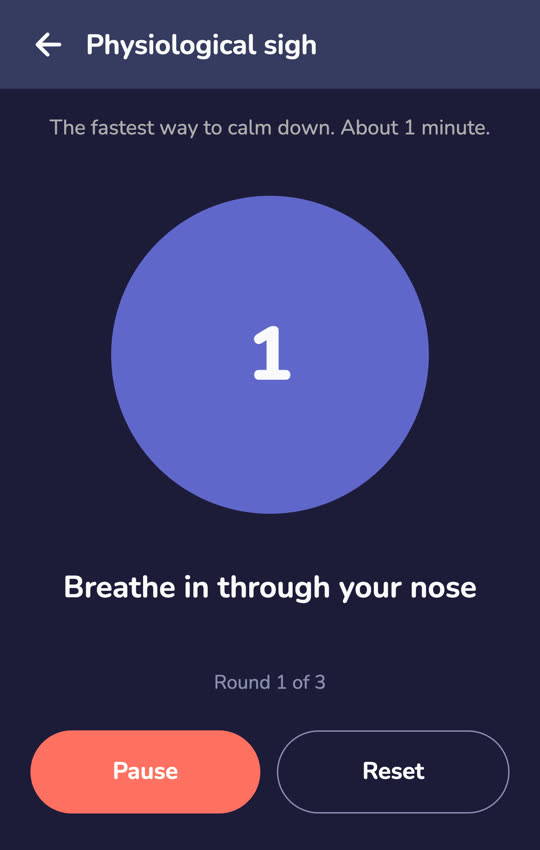
Three to try right now:
- Physiological sigh (about 1 minute). Breathe in through your nose for about 3 seconds. Sip in a little more air for 1 second. Breathe out slowly through your mouth for about 7 seconds. Rest for 3. Do three rounds. This is the cyclic sigh from the Stanford study.
- Box breathing (about 2 minutes). In for 4, hold for 4, out for 4, hold for 4. Six rounds. The even count gives a busy mind something to follow. It was one of the breathing styles in the Stanford study too.
- 4-7-8 breathing (about 1.5 minutes). In through your nose for 4, hold for 7, out through your mouth for 8. Four rounds. It's slow, so a lot of people like it in bed. The Stanford study didn't test it, but it has the same long breath out as the sigh.
If your thoughts are too loud for counting, try 5-4-3-2-1: name five things you can see, four you can feel, three you can hear, two you can smell and one you can taste. It pulls your attention out of your head and back into the room.
If it's a full wave of panic, with a pounding heart and a sense of dread, the clock is on your side. The NHS says most panic attacks last between 5 and 20 minutes. It peaks, then it passes, even when it feels like it won't.
Then talk it through
Once your body settles, the worry is usually still sitting there. Anxiety at night loves a loop: the same thought, a little bigger each lap. Talking it through breaks the loop because you have to put the thought in order. Here's a way that works in four steps:
- Say the worry in one sentence. "I'm scared I bombed the presentation and my boss is going to bring it up."
- Ask what you actually know. Not what you fear. "She said 'thanks, let's talk tomorrow.' That's all."
- Ask if you can do anything about it before morning. Usually the answer is no. If so, write it down for tomorrow and let tonight be done with it. We covered that trick in why you can't stop thinking about work at night.
- If there is something, pick the one smallest step. "Draft two lines I can say if she brings it up." Then stop.
Doing this alone in your head is hard, because the anxious part of you keeps interrupting. Doing it with someone who asks the next question is much easier. At 2 a.m., that someone is usually asleep.
Talk it through with Moodu
Moodu is there at any hour. Open the Anxiety Alleviation conversation and it starts where you are: "Anxiety can be loud. On a scale of 1 to 10, where is it right now, and what's it saying?" From there it talks it through with you one question at a time, and helps you sort what's real from what's the 2 a.m. version.
- Type it or say it. If typing feels like too much, tap the mic and say it out loud. You'll see the words before you send them.
- The breathing exercises are built in. The physiological sigh, box breathing, 4-7-8 and 5-4-3-2-1 grounding each run with a guide and a timer, so you don't have to count.
- It's private. Chats are encrypted before they're saved and never used for ads.
Moodu is $39.99 a year after a 3-day free trial, or $4.99 a week, and every plan includes everything. If the late-night feeling is more lonely than anxious, here's which kind of app helps when you're lonely.
Talk it through with Moodu
Moodu is a kind AI companion you can talk to any time, with mood check-ins, guides and breathing exercises.
3 days free, then $39.99 a year. Or $4.99 a week.
This article is general information, not medical advice. Moodu is an AI companion, not a therapist, and not for emergencies. If you're in crisis, call or text 988 (US) or your local emergency number.