

A self-talk app for when you need to say it out loud


A self-talk app lets you say what's in your head out loud and get it out where you can look at it. The simplest one is the voice recorder already on your phone. A voice journal keeps those recordings over time. An AI you can talk to goes one step further: you say it, and something answers back with a question that helps you think it through. Moodu works that way. You tap the mic, talk for up to two minutes, check the words, and send them.
Why bother saying it out loud at all? Because your mouth is faster than your thumbs, and because naming a feeling does something useful to it.
Why talking it out works
You can keep up with your own thoughts. When your mind is racing, typing is a bottleneck. In a 2016 study by researchers at Stanford, the University of Washington and Baidu, people entered text about three times faster by speaking than by typing on a phone keyboard: 153 words a minute against 52 in English. When you're upset, that difference matters. You get the whole tangled thought out before you lose half of it.
Naming the feeling turns it down. UCLA psychologist Matthew Lieberman and colleagues scanned people's brains while they looked at photos of mostly angry and scared faces. When people picked a word for the emotion ("angry" or "scared"), activity in the amygdala, a part of the brain that reacts to threat, was lower than when they matched the face to another face showing the same emotion. Researchers call this affect labeling. Saying "I'm anxious about Thursday" out loud is a small version of it.
Talking to yourself like a friend helps more. Ethan Kross at the University of Michigan and his colleagues ran seven studies with 585 people and found that using your own name or "you" instead of "I" while thinking through a problem gave people more distance from it. Before a first impression or a public speech, people who talked to themselves this way felt less distress and performed better according to outside raters. After the speech, they dwelled on it less. They also saw upcoming stressors more as challenges and less as threats. "Sam, you've done harder things than this" lands differently than "I can't do this."
A 2-minute way to talk it out
Try this the next time something is spinning. It works with a voice memo, a voice journal or Moodu.
- Say what happened, plainly. Facts first. "My manager moved the deadline to Friday and didn't say why."
- Name the feeling in one or two words. "Mostly I'm anxious. A little angry." If you can't find the word, guess. A close guess still counts.
- Say the scary story out loud. "Part of me thinks this means she's unhappy with my work." Hearing it in your own voice often shows you how big a leap it is.
- Switch to your name. Talk to yourself the way you'd talk to a friend in the same spot. "Okay, Sam. What do you actually know?"
- End on one next step. Small and specific. "Ask her tomorrow at standup whether anything changed."
Two minutes is enough. If you hear yourself saying the same sentence a fifth time, stop repeating it and switch to a question, such as "What would I tell a friend here?" Going over the same worry again and again usually digs it deeper.
Voice memo, voice journal or an AI to talk to?
A voice memo is free, private and instant. It's good for getting something out of your head, but nothing answers back, and you may never play it again.
A voice journal keeps your recordings, and sometimes transcripts, so you can look back and spot patterns over weeks. It's good if you like reflecting. It's still just you.
An AI to talk to answers. That's the difference. When you say "I'm anxious about Thursday," a good one asks what's worrying you about it, which is the question you'd struggle to ask yourself at 11 p.m. It can also reflect back what it heard, which helps you notice the scary story in step 3.
How it works in Moodu
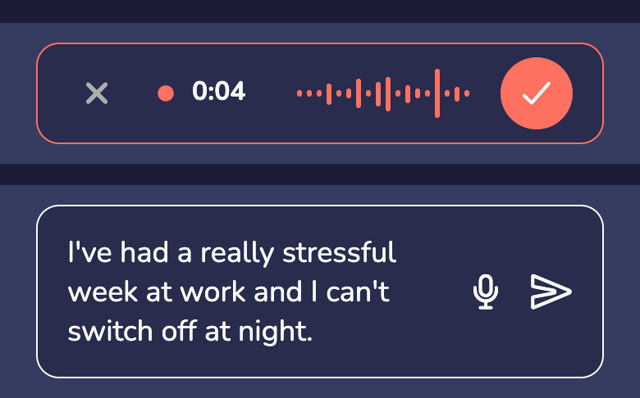
Tap the mic in the chat box and talk. You'll see a timer and a sound wave so you know it's hearing you. Each recording can run up to two minutes. Tap the check mark, and what you said shows up as text in the chat box. Fix anything it misheard, cut what you don't want to send, then send it. Moodu replies in writing, so you can read it back at your own pace.
A few details people ask about:
- The audio isn't kept. Moodu turns your recording into text and only saves the conversation.
- Your chats are private. They're encrypted before they're saved and never used for ads.
- Voice works in Moodu's web app right now, in your phone's browser or on a computer.
- It also has guided conversations for things like stress, sleep, anxiety and breakups, so you can start with a topic instead of a blank screen.
Moodu costs $39.99 a year after a 3-day free trial, or $4.99 a week, and every plan includes voice. See pricing.
If what you need to say out loud is mostly loneliness, here's which kind of app helps when you're lonely. If it's the worry that shows up when you try to sleep, start with why you can't stop thinking about work at night, or who you can talk to when you're anxious at 2 a.m.
Talk it through with Moodu
Moodu is a kind AI companion you can talk to any time, with mood check-ins, guides and breathing exercises.
3 days free, then $39.99 a year. Or $4.99 a week.
This article is general information, not medical advice. Moodu is an AI companion, not a therapist, and not for emergencies. If you're in crisis, call or text 988 (US) or your local emergency number.