

Is it worth tracking your mood?


Yes, if it takes you seconds and you actually look back at it. Tracking your mood does two things. In the moment, naming how you feel takes a little of the edge off. Over weeks, the check-ins add up to a picture you can't see from inside a single bad day: which days dip, what comes before a good stretch, and whether the thing you're trying is working.
What the research says
The in-the-moment part comes from what psychologists call affect labeling. In a UCLA brain-imaging study, putting a feeling into a word turned down activity in the brain's threat response. We covered that in why saying it out loud helps.
The over-time part has been tested too. In a randomized trial of 114 young people aged 14 to 24 with at least mild symptoms of depression, those who tracked their mood, stress and daily activities on their phones became more aware of their emotions than a group that only logged activities, and that awareness went along with fewer symptoms of depression. The researchers' takeaway was simple: noticing how you feel, regularly, is useful in itself.
What to track (keep it tiny)
- One mood a day. Four options is plenty. A 1-to-10 scale sounds more precise, but it's one more decision on a day you're already tired.
- One line on the days something happened. "Skipped lunch, long meeting." "Saw Sam." "Slept 5 hours." That line is what makes the pattern make sense later.
- The same time each day. Bedtime works for most people, because the day is done.
That's it. If it takes more than about 10 seconds, you'll stop doing it.
What a month shows you
After a few weeks, patterns start to show up. The kind of thing to look for:
- A day of the week that dips. Sunday evening, say, or the middle of the work week.
- What comes before your good days. Sleep, a walk, a call with a particular person.
- What comes before your bad ones. A certain meeting, a late night, too much time alone.
- Whether a change is working. Started walking at lunch? A month of check-ins tells you if your mood moved, instead of you guessing.
It also helps on a bad day. When you can see three Good days last week, "I always feel like this" is easier to argue with.
How Moodu's tracker works
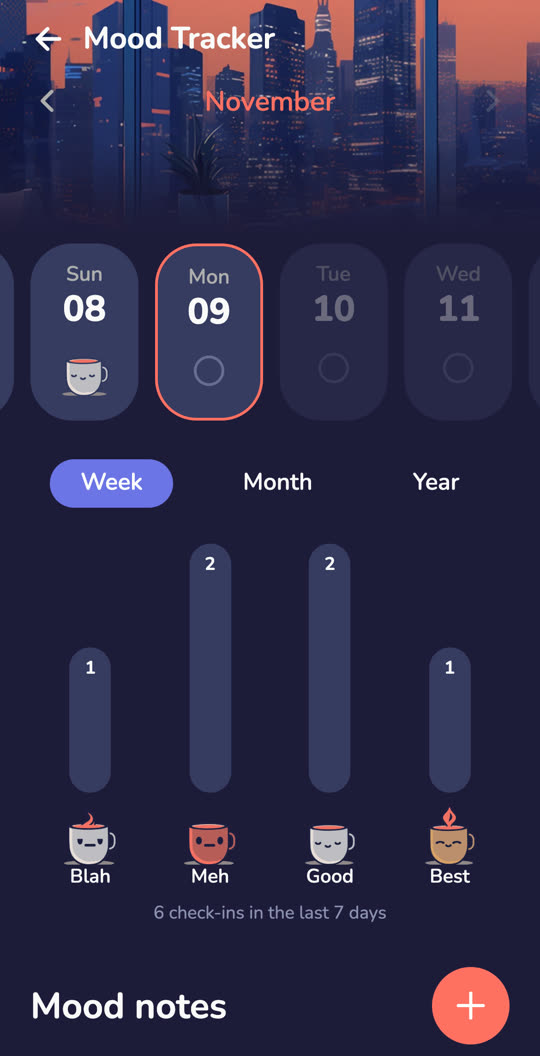
Moodu keeps it to one tap. On the home screen, pick the mug that matches your day: Blah, Meh, Good or Best. On a Blah or Meh day, Moodu offers to talk about it right there, and opens with "I saw you're feeling meh today. Want to tell me what's going on?"
- Week, month and year views show how many of each mood you've had, so you can zoom out.
- Mood notes hold that one line about what happened.
- It's on every device. Your check-ins and notes sync to your account.
- It's private. Check-ins and notes are encrypted before they're saved and never used for ads.
Moodu is $39.99 a year after a 3-day free trial, or $4.99 a week, and the tracker comes with everything else: guided conversations, breathing exercises and guides.
Trying something new to feel better? Check in before and after, then see what changed. A good place to start is a mental health day that actually helps, or if nights are the hard part, what helps when you're anxious at 2 a.m.
Talk it through with Moodu
Moodu is a kind AI companion you can talk to any time, with mood check-ins, guides and breathing exercises.
3 days free, then $39.99 a year. Or $4.99 a week.
This article is general information, not medical advice. Moodu is an AI companion, not a therapist, and not for emergencies. If you're in crisis, call or text 988 (US) or your local emergency number.